
 As a junior-high school teacher once told me, "Two bullies on the same block
fight." Well, maybe the two contenders shooting it out for our "King of New
Muscle" title aren’t bullies, but a shootout between Buick’s was bound to
happen. Each car is a high-priced, high-powered machine possessing knockout
power.
As a junior-high school teacher once told me, "Two bullies on the same block
fight." Well, maybe the two contenders shooting it out for our "King of New
Muscle" title aren’t bullies, but a shootout between Buick’s was bound to
happen. Each car is a high-priced, high-powered machine possessing knockout
power.
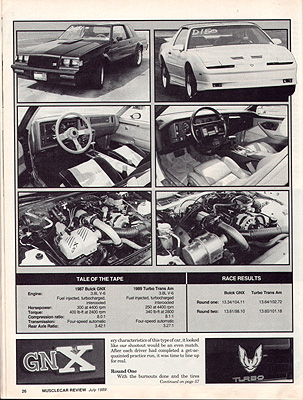
Turbocharging, the manufacturers’ preferred method of making horsepower in the 1980s, reached its peak in the Buick GNX and GNX owners have become justifiably smug knowing that their sinister-looking Buicks have precious few equals. But when Pontiac announced the Anniversary T/A would be powered by an improved Grand National engine, Buick guys (and gals) were less than overjoyed to learn that their mighty V-6 would no longer be a Buick exclusive. To determine who gets the bragging rights, Musclecar Review brought two untouched and low-mileage examples of each make to duke it out once and for all. The GNX was a proven pavement-pounder, but just how fast was this wise-guy Pontiac, anyway?
Buick GNX
Roy West offered his 132-mile, unmodified GNX to joust with the high-powered Poncho. Built as a commemorative farewell edition of the rear-wheel drive Regal, the red-hot, V-6-powered GNX offered the kind of acceleration not available in an American sedan since the glory days of the musclecar. Remember when one horsepower per cubic inch was big stuff? The GNX cranked out 300 horsepower at 4400 rpm with just 231 cubic inches. Quarter-mile times in the mid-13 to low- 14-second range are no problem for a stock GNX.
Turbo Trans Am
By the time you read this, all 1,500 20th Anniversary Trans Ams will have been sold. Pontiac wanted a zoomy T/A to spice up the F-body line and the Turbo Trans Am was just what the doctor ordered. Under the hood is a revised version of the Grand National V-6. Cylinder heads from the transverse 3800 V6, sporting identically sized valves and less mass on the exhaust side, were used because of tight engine bay clearances. The T/A uses the same sized turbo as the GN, but with the GNX intercooler. Engineers also bolstered the block with high-nodular main caps and a cross-drilled crank. But these modifications are intended to handle horsepower, not make it. Having owned the car only a month, Lee Gorman’s brand new T/A had less than 100 miles on the clock. Like the GNX, the 3,464-pound turbo Trans Am was untouched.
The Drivers
Besides owning a Trans Am, Lee has a Buick GN that he enjoys racing on weekends, so he’s no stranger to this powertrain, but this was his first time on the track with the Trans Am. It turns out that Gorman and Roy West, the GNX owner, are racing buddies. While Lee flogs his Grand National, Roy does the same with his ‘86 T-Type. Since the cars were untouched and virtually brand new, and both drivers were familiar with the power delivery characteristics of this type of car, it looked like our shootout would be an even match. After each driver had completed a get-acquainted practice run, it was time to line up for real.
Round One
With the burnouts done and the tires heated, the cars staged. Both drivers power-braked to bring up rpm and create positive boost. As the lights tripped down, the GNX left the line at 2300 rpm on a .604 reaction time while Lee cut a .711 reaction time and brought the T/A out at 2000 rpm. Neither car had traction problems but the GNX got the jump. As they cleared the tree, the GNX was on top with a decisive lead. Turbos huffed and puffed as the two high-tech terrors marched toward the big end. Through the traps it was the GNX first with an impressive 13.34/104.11 while the Trans Am posted a 13.64/102.72. Back in the staging lanes, Lee told us he was soft-pedaling the T/A off the line to prevent wheelspin. Would a harder launch and a slightly quicker reaction time take the Buick or would the GNX continue to reign as New Muscle King?
Round Two
The Trans Am staged in the tower lane and the GNX took the far side, as in round one. Yellow, yellow, yellow, off brakes, green. The GNX moved first, cutting a razor sharp .521 reaction time, but the Turbo T/A was hot on its heels with a .665. This time we had a much more even race on our hands. Under full-boost, the cars rocketed down mid-track toward the traps. We had a winner. By the narrowest of margins, the GNX took the win—and the shootout—with a 13.61/98.10; one hundredth of a second slower than the T/A’s losing, but quicker 13.60/101.18 ET.
And The Winner Is...
The big, bad Buick won fair and square, but with the numbers this close, either car could win on a given day with the right driver and vehicle condition. But this shootout belonged to the GNX...by a whisker.
